
Book Feature: I Don’t Want to Go to the Hospital!
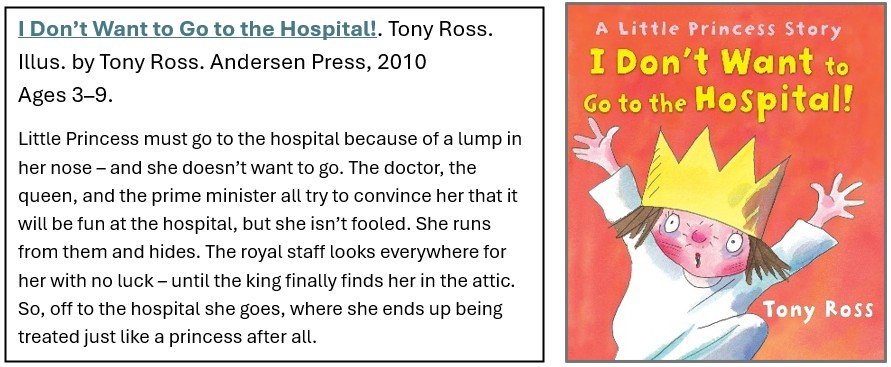
Whether planned or unexpected, hospital visits can be scary for children. Reading this book with your child can help validate their fear, without adding new concerns. This book brings a bit of absurdity, casual silliness, and fun to a challenging experience, and the diagnosis of “a lump in her nose” is non-specific enough that It could fit many situations.
Watch a read-aloud here: I Don’t Want to Go to the Hospital! — a full narrated version of the story you can share with your child to help them hear the book in a comforting, fun voice.
The Little Princess series by Tony Ross, also includes books about bedtime, baths, independence, and common early-childhood struggles. The ink and watercolor illustrations add much to the story with simple lines and vivid colors, and the unconventional characters and chaotic scenes add unexpected details that can spark discussion.
Little Princess is a relatable character—stubborn, expressive, dramatic, and always contrary, but lovable. Children can revel in her mischievous behavior without getting themselves in trouble! This can lead to insightful conversations about what your child is thinking and feeling around their own hospital stay.
Take Note:
The book uses humor to ease fear; if your child is very anxious, it may be helpful to insert simple explanations of their own upcoming visit while reading about Little Princess.
There are no graphic medical details—just child-friendly (and funny) scenes of checkups and hospital care.
Little Princess does get worried, and strongly resists going to the hospital, which can validate your child’s feelings but might also spark fears or concerns – take some time to talk through those feelings.
The ending is funny, sassy, and reassuring, making it safe to read before most hospital stays or procedures.
What Resonates with Kids:
Little Princess’s dramatic reactions and the book’s expressive artwork.
Many fun details to find in the illustrations (Is that a cat dining on the roof?).
Humor that makes scary things feel a little safer.
Absurd behavior of adults from a child’s point or view.
Seeing the special treatment Little Princess gets from the grown-ups taking care of her in the hospital.
A funny and comforting ending that shows Little Princess back to herself again.
Follow-up Activities & Conversations
Use the book as a guide while planning what to pack for a hospital admission. (What would Little Princess bring?)
Make a Little Princess crown and add a jewel, sticker, or ribbon each time a poke, procedure or treatment is completed.
While waiting for discharge, ask your child what they would tell Little Princess about what to expect at the hospital.
Read another title from the Little Princess series to see how Little Princess reacts in a different situation.
Other Recommended Titles
Bennett, Howard J. Harry goes to the hospital: a story for children about what it's like to be in the hospital. Illustrated by Michael S. Weber. Describes the experiences of a young boy after he is admitted to the hospital and walks children through the hospital experience in a straightforward, informative, and reassuring way.
Brown, Lisa. The Hospital Book. Neal Porter Books, 2023. A young girl with appendicitis recounts her strange and scary trip to the hospital, and the nine times she cried--and a few times when she did not. The comforting tone and step-by-step descriptions of everything that happens are calming. Cartoon illustrations gently depict procedures such as an ultrasound and IV insertion and add some humor.
Fergus, Maureen. You’re in Good Paws. Illustrated by Katheryn Durst. Toronto, ON: Tundra Books 2019. Slightly distracted parents accidentally take their son, Leo, to the animal hospital to get his tonsils out. Luckily, taking care of a human doesn't ruffle any feathers among the hospital staff. The chicken at the admissions desk is welcoming, the bear orderly is friendly, and wise Dr. Stan inspires tremendous confidence despite being a mouse. Is the plastic cone really necessary, though?
Bibliotherapy, using books in a supportive, intentional way, helps children explore feelings safely, connect with characters who understand their struggles, and open up conversations that might otherwise feel overwhelming. With the right book and a few simple steps, reading together becomes more than a quiet moment, it becomes a pathway to coping, confidence, and emotional wellbeing. Learn more about Bibliotherapy here:

Written by: Nancy Seeger, mother of two magnificent children (now adults), and currently a part-time Branch Services Assistant at the Cuyahoga County Public Library. As a health librarian for 17 years, Nancy Seeger had the privilege of helping parents at the Family Resource Center at University Hospitals Rainbow Babies and Children’s (Cleveland, Ohio). Librarianship is her second career, having spent 12 years as a special education teacher with Deaf and hard-of-hearing students in Beachwood, Ohio.